Beekeeping as a livelihood.
In a region where the most common threats to the forest are the ones born of need — clearing land to farm, cutting timber to sell, hunting to get by — beekeeping offers something rare: an income that depends on the forest staying intact. A healthy hive needs healthy, flowering forest around it, which means a beekeeper's livelihood and the land's protection point in the same direction.
The payoff runs in more than one direction: beekeepers earn from honey and wax, neighboring farms see better yields from the pollination, and the forest gains a community with a direct, practical reason to keep it standing.
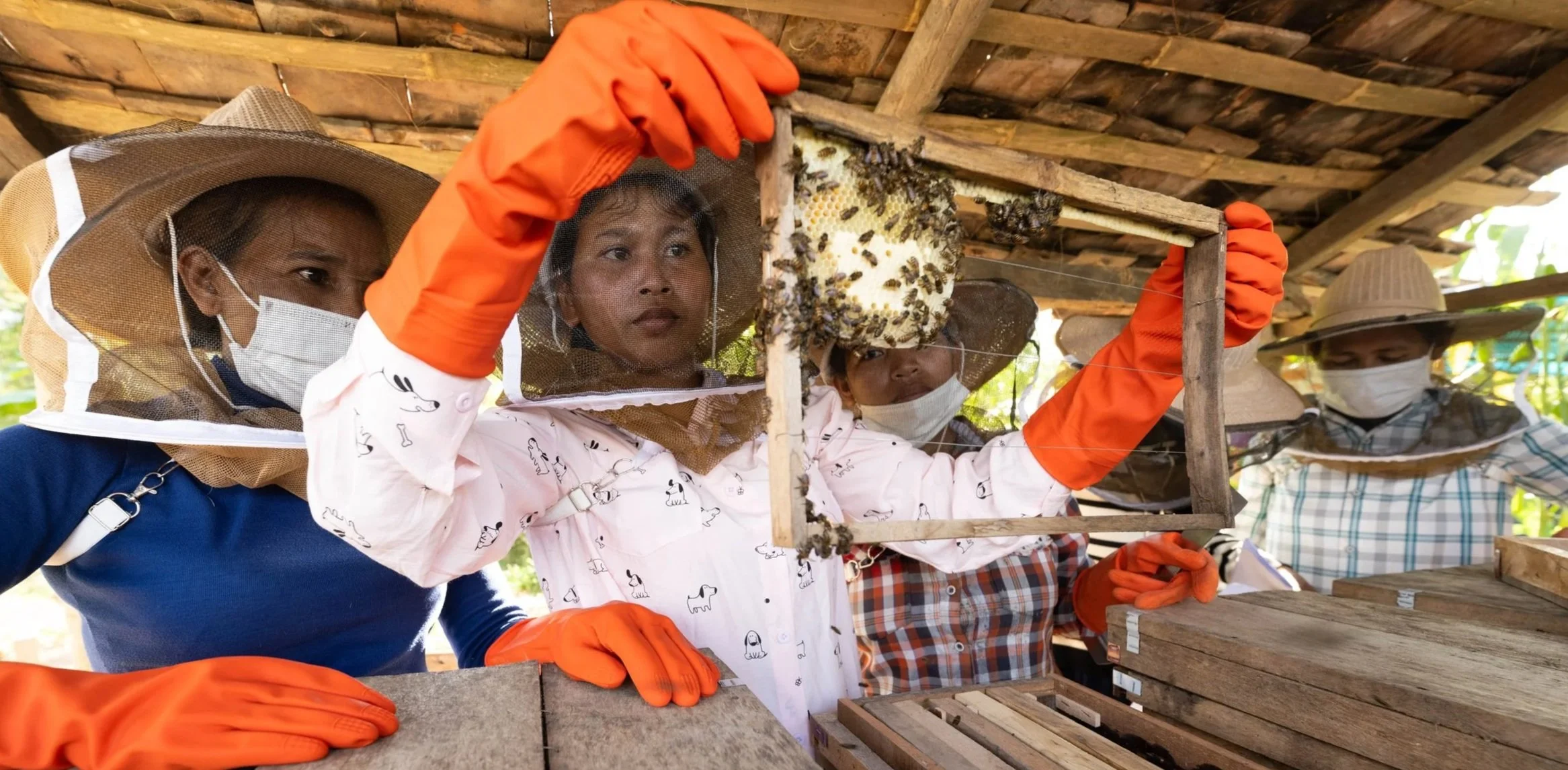
That’s why the Maddox Foundation trains local beekeepers in the forests around Samlaut, who produce between 800 and 1,500 liters of honey a year. In 2025, they produced 1,392 liters of honey.
But that number is only part of the picture. Through late 2025 and into 2026, our beekeepers made a deliberate choice: rather than extract as much honey as possible, they prioritized building up their colonies first.
The result was a near-doubling of hives, from 40 in September 2025 to 90 by January 2026.
The program has also grown more self-sufficient. Beekeepers now make their own beeswax foundation sheets — 600 sheets from 20 kilograms of wax — cutting a recurring cost that used to depend on outside suppliers. And to follow the nectar, the hives travel: colonies are moved seasonally between Samlaut and Kampong Cham and back, tracking the flowering seasons across provinces.
In the past, our pollination work has been done with partners; it is now an area of focus we aim to expand. After a series of awareness sessions, 26 farm owners in neighboring lands agreed to host hives and reduce their pesticide use: a direct link between healthier bees, better crop yields, and safer fields.
We're also planting for the bees themselves, adding bee-forage trees at the Maddox Foundation bee farm and at Phnom Deka community forest.
Much of this effort is about putting beekeeping in the hands of women.
For World Bee Day 2022, we partnered with Guerlain and UNESCO to launch the second cohort of the #WomenForBees program in Cambodia.
In the clip below, our founder Angelina Jolie joins beekeeper Aggelina Kanellopoulou — a graduate of the 2021 cohort — in Cambodia to share experiences and exchange best practices with the women in the program.